











For most seniors, college decisions aren’t just emails, they’re moments. Moments of relief, excitement, and sometimes disbelief after months of stress, essays and waiting.
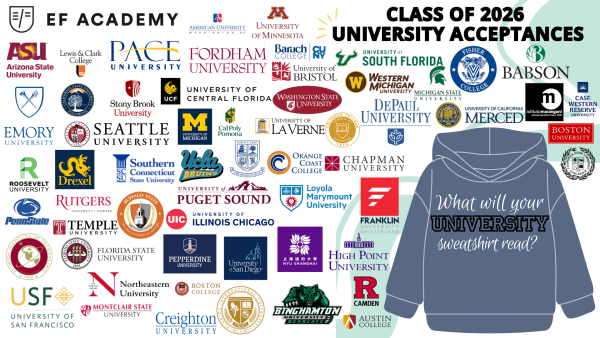
At EF Academy, students are finally starting to hear back from universities, and while every story is different, one thing is the same: getting accepted means a lot more than just getting in.
Juha Park, who was accepted to Boston University for Film and Television, described the feeling as both exciting and overwhelming. “I’m excited to meet new people, new professors, and just experience more independence,” she said. “And finally study something I actually care about.”
But behind that moment was a lot of pressure. “The hardest part was balancing everything–school, essays, deadlines and just the stress of waiting,” Park explained. As an international student, she also had to deal with extra planning and documents, which made the process even more intense.
When the decision finally came out, she didn’t hesitate. “I told my parents first. They’ve always supported me, so it just felt right.”
Not everyone had the same experience. For Ana Maldonado Moran, who plans to study Interior Design at Marangoni, the process felt much simpler. “Honestly, it was pretty easy,” she said. Instead of stress, she’s focused on what’s ahead. “I’m just excited for the opportunities I’ll have.” When she got accepted, the first person she told wasn’t family, it was her best friend Margo Uruma.
Franciszek Czajkowski, accepted to Webster University Geneva for Economics, is looking forward to something new. “A new start, new environment, new place,” he said.
For him, the most challenging part wasn’t deadlines or stress, but writing his motivation letter. Still, like many others, he shared the moment first with his parents. “They’re the most important people in my life.”
While these experiences may seem different, there’s a bigger picture behind all of them. According to University Advisor Jay Shamlin, getting into college today is about much more than just grades.
“Strong academics are just the baseline,” he explained. “A lot of students have similar grades, so what really matters is what you do outside the classroom.” Universities are looking for students who show passion, take initiative, and actually care about what they want to study, not just those who check boxes.
For international students, the process can be even more complicated. “It’s both an advantage and a challenge,” Shamlin said. “They bring diversity, but they’re also competing globally for limited spots.”
His biggest advice for Juniors? Start early. “Do your work! Senior year gets overwhelming really fast,” he said. “The students who are consistent and start during junior year have a much easier time.”
He also pointed out something many students don’t realize: getting rejected doesn’t mean you’re not good enough. “It’s not always personal,” he explained. “Universities are building a community, not just picking the best grades.”
At the end of the day, college acceptance isn’t just about where you go, it’s about everything it took to get there. The late nights, the stress, the uncertainty… and finally, the moment when it all pays off.